So many life-and-death issues are on the line in the upcoming election: the speed and scale of climate/planetary breakdown (i.e. the habitability of our planet); protecting women’s lives, personhood, bodily autonomy, and medical privacy; protecting Social Security, Medicare, Medicaid, and affordable ACA health care plans; reducing gun violence massacres and tragedies; protecting marginalized and dehumanized groups of people; protecting and expanding workers’ rights and economic justice; the appointment of future Supreme Court justices and other judges whose decisions will have far-reaching impacts on our lives; the handling of future pandemics; and preventing the use of nuclear weapons, to name just a few.
I know it seems like people always say “This is the most important election of our lifetime.” In a sense, it’s almost always true, if you just add “…so far.” We can’t go back and change the outcome of past elections, and we don’t know what future elections will look like. But every election is extremely important and every outcome has serious and lasting consequences for our everyday lives—and many issues are becoming more dire over time—so the next election is always going to be the next best chance we have to influence the conditions we will be living under in the short term and the long term.
This election is different from previous elections in some important and disturbing ways:
 1) New voter suppression laws and tactics are in effect: Since the last Presidential election, some states have passed laws instituting rules that will make it harder for certain groups of people to vote and even to register to vote (especially young people and students, people with disabilities, poor and homeless people, and the elderly), which could disenfranchise many of them. For example, tens of millions of voting-age citizens don’t have the types of voter ID that are now required in their states, and many are not aware of the ID requirements.
2) Insurrectionists are in office and running for office: This is the first Presidential election since the January 6th insurrection (attempted coup) happened. A number of current elected officials at state, local, and federal levels (and other people who are now running for office) participated in that insurrection in one way or another, or are still actively denying the results of the 2020 presidential election (propagating the Big Lie); and many of them are already saying that they will not accept (or certify) the outcome of an election that does not go their way. We have a patriotic responsibility to vote against insurrectionists and election deniers; and
3) AI deepfakes and “cheap fakes” (video, audio, and images) can now easily be manipulated to impersonate candidates or others, or to show excerpted statements completely out of context, to confuse or misinform voters. It can be difficult to tell what is fake or real, and even if they are debunked, last-minute deepfakes before the election could have an effect on how people vote (or whether they vote at all). Intelligence officials are warning that Russia (as well as China and Iran) have been using fake accounts on social media to spread disinformation and sow division in the U.S. They do this through many means, deepfakes being one of them.
If the U.S. allows a corrupt, sociopathic, Putin-subservient, adjudicated sexual predator and defamer, convicted felon, compulsive liar, grifting conman, and wanna-be dictator (along with his criminal henchmen, “yes men,” and corrupt family) to take power for a second time, it will likely be the end of our long, admirable experiment with American democracy and it could be the last legitimate election we have for a generation or more.
Many people don’t realize how quickly a country can lose its freedoms and how far it can fall in the hands of an authoritarian. Our democracy is far from perfect now, but things can get much, much worse. Basic rights that we take for granted could suddenly be stripped away. We should learn from the recent experiences of countries like Hungary, Turkey, and Belarus. I cannot overstate or adequately express how much I don’t want to live out the rest of my life under that type—or any type—of anti-democratic, authoritarian, or theocratic rule—and how much you and almost everyone else would hate it and suffer because of it, as well.
Ways to help voters and Get Out the Vote
Elections are decided by those who show up to vote and who vote for one of the viable candidates (in the U.S. system, third-party candidates are not viable at the national level), and particularly by voters in “swing states,” which will determine the Electoral College outcome of the Presidential election (please click here to tell your state representatives to pass the National Popular Vote Law in your state; it has been passed in 18 states so far and is getting close to the threshold needed to go into effect).
Current “swing states” include: Wisconsin, Pennsylvania, Nevada, Arizona, Georgia, Michigan, North Carolina, New Hampshire, and Florida. Other “purple” states include: Ohio, Texas, Minnesota, Virginia, Montana, New Mexico, Colorado, Maine, Iowa, Kansas, Alaska, Nebraska, Missouri, South Carolina, and North Dakota, among others.
Here are some ways that each of us can make sure people are able to vote and to protect the election and democracy:
- Look up your state’s voter registration deadline and share that information with others you know, including anyone who might not yet be registered (or who has moved recently and might need to re-register). In some states, people must be registered more than a month before the election in order to vote in that election, while a few states allow people to register right up to or on Election Day.
- Remember to check your registration status to make sure it’s still Active, at least once a year (including just over a month before each election, when you should still have time to re-register) and remind others to do so, as well. Go to your state’s Elections/Secretary of State website, or contact your county’s Elections office to check your registration, or go to Vote411.org. You should also make sure your registration has your correct, current address. Some states are doing overly aggressive purges of their voter registration rolls to “clean them up” but they often remove people who should not be removed. If your name has been improperly removed from the list of voters, you should not only contact your Secretary of State’s office but also file a complaint with the Department of Justice (online at civilrights.justice.gov, or by calling 1-800-253-3931). In some states, you can register to vote on Election Day (and/or during Early Voting) in person, at your polling place.
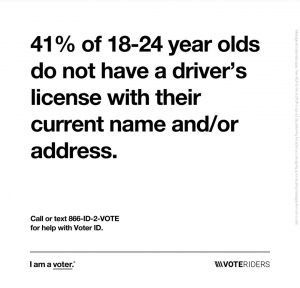
- Make sure people in your state (and people you know in battleground/swing states) know what types of ID are required for voting there now. In the last year or two, the requirements in some states have gotten much more stringent (for example, some states will not accept student IDs now). Did you know that 11% of American adults (26 million people, including many young people, elderly or disabled people, and low-income people) don’t have a current photo ID? If someone needs assistance with obtaining the required ID or getting it free of charge, they can call or text the VoteRiders hotline: 866-ID-2-VOTE (866-432-8683), or email info@voteriders.org (or contact Spread the Vote/Project ID).
- There is a much greater need for poll workers than ever before. Sign up to be a paid poll worker through Power the Polls. It’s important to sign up well before the election so you will have time to get the required training. Because the GOP is threatening to use voter intimidation tactics at some polling places, and because some new poll workers might not always provide correct information to voters, it’s also necessary to have fair-minded poll monitors, or “poll watchers” or “election observers” on hand. Sign up to be a nonpartisan Election Protection volunteer (you can also sign up via Common Cause); there are different roles you can choose from, to help on site or from home. (Alternatively you could sign up as a partisan poll watcher through your local or state Democratic Party office.) Those who have a legal background (lawyers, paralegals, and law students) can volunteer through WeTheAction.
- Support some voting/election-related organizations (or campaigns) now. Please don’t wait until the fall to start helping them; that could be too late to make a difference. Here are some groups to consider supporting (or volunteering for):
- There are many different ways you can volunteer to help Get Out the Vote, in your state or in one or more of the swing states that will determine the Electoral College outcome of the election. You could volunteer for a specific candidate or campaign, or with your state or local Democratic party. Or you can do postcarding (or writing letters), texting, or calling voters through groups like:
You can find other ways to be involved in expanding voting access and supporting democracy in the Americans of Conscience Checklist, or through many of the other organizations listed under item #5, above.
7. Vote Early, and encourage everyone else to do so, as well. Contact your county’s elections office to find out where and when you can go to Vote Early in your county (the locations are probably different than your Election Day polling place). On Election Day, there will be long lines at some polling places, and this year it will not be surprising if there are bomb threats (most of which are likely to be hoax calls but could still temporarily shut down some polling places) and various other attempts to intimidate voters or interfere with or delay people’s ability to vote.
8. If you’re voting via mail-in/absentee ballot, it’s safest to drop it off at your county’s elections office (indoor dropbox, if available) as early as you can. If you mail it, follow all instructions, sign where indicated, and be sure it has enough postage (some ballots might require more than 1 stamp); and mail it at least a week before the election to make sure it will arrive by Election Day. (If you can mail it at a Post Office and get it postmarked at the counter, even better.) If it’s less than a week before the election, it’s safer to bring it to your county elections office or other designated drop-off locations in your county. TRACK YOUR BALLOT status. If you are informed that you need to do something to “cure” your ballot (e.g., due to a signature matching issue, ID, missing envelope, etc.), please follow up to fix it immediately. The sooner you get your ballot in, the more time you should have to take care of any problems. Help contact others with rejected ballots that need to be “cured.” 
9. Spread the word that anyone who has questions about voting or who experiences or witnesses any problems with voting (including voter intimidation, voter suppression, uninformed poll workers, etc.) can call or text the Election Protection hotline: 866-687-8683. (More info here.) If a problem is not resolved at your polling place, also report it to your county elections office/administrator. If it’s a significant or widespread problem, you could also report it to your Secretary of State’s elections division, your local or state Democratic Party, the DOJ (at civilrights.justice.gov, or 1-800-253-3931) and/or to local news outlets. People whose names are missing from voter registration list should demand to get a “provisional ballot” at the polls and then follow up to make sure that it will be counted. In some states, you can register to vote on Election Day (and/or during Early Voting) in person, at your polling place.
Other related posts:
#VoteReady #GOTV #VotingMatters #ClimateVoter #YouthVote #VoteLikeYourLifeDependsOnIt #WomensLivesMatter #DemocracyMatters #DemocracyIsOnTheBallot
May 9, 2024
 The Goldman Environmental Prize is the world’s largest and most prestigious annual award for grassroots environmentalists. Some people refer to it as the “green Nobel.” Goldman Prize winners are models of courage, and their stories are powerful and truly inspiring. “The Prize recognizes individuals for sustained and significant efforts to protect and enhance the natural environment, often at great personal risk. Each winner receives a financial award. The Goldman Prize views ‘grassroots’ leaders as those involved in local efforts, where positive change is created through community or citizen participation in the issues that affect them. Through recognizing these individual leaders, the Prize seeks to inspire other ordinary people to take extraordinary actions to protect the natural world.” Over the 36 years that the Prize has been awarded, there have been 226 recipients of the prize.





 Those of us who have been paying attention and understand the threats and troubles that are coming to almost everyone in the U.S. (and to the health of our air, water, lands, ecosystems, and climate) will be among those who are most ready and equipped from the outset to try to reduce some of the harms. None of us gets to choose the era we live through or to control a whole lot about the world we live in. But we should strive to rise to the challenge of the situation we face, by doing what we can to make our communities, our country, and our world as livable (and worth living in) as we can. We can strive to be among the lights that will guide the way through the darkness.