social justice

“The idea that some lives matter less is the root of all that is wrong with the world.”
– Dr. Paul Farmer

“I happen to think that the singular evil of our time is prejudice. It is from this evil that other evils grow and multiply. In almost everything I’ve written there is a thread of this: man’s…palpable need to dislike someone other than oneself.”
– Rod Serling

“Please try to remember that what they believe, as well as what they do and cause you to endure does not testify to your inferiority, but to their inhumanity.”
– James Baldwin, from The Fire Next Time

“The death of human empathy is one of the earliest and most telling signs of a culture about to fall into barbarism.”
– attributed to Hannah Arendt (unverified)

“Whoever can make you believe absurdities can make you commit atrocities.”
– Voltaire  (a rough translation from the French)


Biases that people form against other people can revolve around all kinds of identities, real or perceived, including: nationality, skin color (“race”), ethnicity, religious affiliation, gender/gender identity, sexual orientation, immigration status, political affiliation, class, region, urban/rural location, or other group affiliation.

Rather than allowing ourselves to embrace an Us vs. Them mindset, in which we perceive other people or groups of people as abstract, generalized Others—caricatures that we can readily vilify or scapegoat or cast as “enemies”—we should always try to “put ourselves in other people’s shoes” and notice that there are more similarities between people than differences. We must try to see each person as a multi-faceted individual and not just as one identity; and we must understand that everyone’s life has value and each person has as much of a right to life and liberty as we have.

As soon as a person allows himself or herself to generalize about an entire group of people and to believe that They (the Others) are inherently inferior or lesser than one’s “in group” in some way: e.g., stupid, primitive, dirty, untrustworthy, devious, scary/dangerous/violent/criminal, bad, or evil—or the group one identifies with is inherently better than (i.e., superior to) another group of people, simply because of the place or the identity that they were born into or have chosen—that person has stepped onto a slippery slope that can lead to discrimination, hate speech, dehumanization, exploitation, violence, and potentially to atrocities. Wrong-headed, misguided thoughts often lead to wrong-headed speech or “rhetoric” (which can spread those thoughts to others), which can all too easily lead to wrong-headed actions—at an individual level and at a societal level.

The slippery slope (or pipeline or staircase—choose your metaphor) can gradually take a person from:

  • basic bias, generalization, prejudice and “othering,” to…
  • scapegoating (collective blame)bigotry (e.g., racism, misogyny, homophobia, transphobia, Islamophobia, anti-semitism, xenophobia, etc.), and using slurs and hate speech, to
  • discrimination, bullying, and harassment of individuals in that group, to
  • dehumanization or objectification, demonization/vilification, and hatred, to
  • humiliationdominationexploitation, detention/enslavementindiscriminate prosecution or persecutioncrueltybrutality, sexual violence, or other violence/hate crimes inflicted on individuals in that group, to
  • collective punishment and harm aimed at everyone perceived to be in that group, to
  • comfort with (and then celebration of or potentially even participation in) the murder of people who belong to that group, to
  • comfort with (and then celebration/promotion of or even participation in) mass murder, “ethnic cleansing,” war, and genocide.

Of course, not everyone continues to the end of this pipeline or exhibits all of these behaviors; most people draw a line somewhere along the way, but in the meantime, their othering or hatred could have spread to others who might end up going further.

Sadly, sometimes all it takes to get onto this pipeline is: a lack of self-knowledge of one’s own biases (we all have biases) and an inability to put those biases in check. Biases often stem from feelings of: fear, insecurity, self-pity, resentment, grievance, personal failure, inferiority, social isolation, or a lack of belonging. Then, when you add in repeated exposure to some hate speech or propaganda (scapegoating/misplaced blame, lies, disinformation)—which could come from one’s family members or peers, one’s religious leaders, social media, hate groups, weaponized bots, mass media, or one’s own government—that combination of factors can make some people go beyond their basic prejudice and bigotry, become radicalized, and turn against their fellow humans, deciding that those humans are “the enemy” or that their lives are worth less (or worthless and expendable)—or taking it a step further, that they should be exterminated.

These are some of the steps that were outlined above, laid out in a little more detail:

  1. Not liking or respecting most or all of Them (the Others/Outsiders, who have been deemed a disfavored group).
  2. Looking down on Them (or being scared of Them) and feeling that They, as a whole group, are inferior from one’s own group.
  3. Deciding that they should be second-class citizens, it’s OK to discriminate against them, and that they do not deserve equal protection under the law or all of the rights (civil rights, constitutional rights, voting rights, immigration/refugee rights) that are granted to the In group.
  4. Feeling or declaring that they are sub-human in some way: e.g., “animals” or “vermin” or “impure” or “poisoning our blood,” or just objects/“bodies” or property, or evil “invaders” (aiming to “replace” the In group) or “the enemy, and that therefore they do not deserve basic human rights.
  5. Feeling that they are expendable, that it’s acceptable if some of them suffer, are exploited, are kept in inhumane conditions, are harmed by violence, or die from neglect or abuse or deportation back to an unsafe country, and if they’re sick or injured or wounded or vulnerable, we should let them suffer or die.
  6. Feeling that they deserve to die, and that someone should kill some of Them.
  7. Feeling that the State should kill some of Them, and supporting those killings.
  8. Feeling that the State should kill (exterminate) most or all of Them.
  9. Being willing to kill Them oneself (whether one is acting independently, as part of an organized group, or as part of their country’s military).

It’s never OK to collectively blame (scapegoat) or to collectively target, punish, or harm, let alone kill, people for the actions of their country’s or their group’s so-called leaders, or for the extreme or violent actions of a few individuals within a group, a protest, or a country. Many—and in some cases, most—people strongly disagree with their government’s or their current leaders’ actions. And individuals who commit acts of terrorism or violence rarely represent the wishes or beliefs of the majority of the larger groups they might be identified with. Even if the majority of a group does happen to agree with the offenders, consider that there are always some in the group who don’t, and it should be widely understood they do not deserve be targeted or punished just because they happen to share the same general “look” or identity (which is often an immutable identity or a group/country that someone was born into) as the offending individuals or leaders.

In Nazi Germany, the disfavored groups of inferior Others included many groups, not solely the groups they considered “non-Aryan.” The long list of people who were persecuted by the Nazis (and killed in large numbers during the Holocaust) included: Jews, Romani, as well as many Polish people, Slavs, and Ukrainians; people with physical or mental disabilities, blacks, gay men, political dissidents, pacifists and draft resisters, civilians engaged in non-violent resistance, Germans who had lived abroad for an extended time, Catholics, non-Europeans, and “social deviants,” which was a broad category that included alcoholics, drug addicts, vagrants, prostitutes, and common criminals (e.g., thieves).

The American Far Right has a white supremacist and Christian Nationalist cult-like bent (which is now well-represented within the current Administration, Congress, and government agencies). Among the many groups that have been targeted or scapegoated by the the Right are: trans people (who make up less than 1% of the population), Muslims, Jews, immigrants and refugees (primarily those who are brown- or black-skinned and/or who immigrated from poor countries—while a century ago, the disfavored immigrant groups included Jews, Irish, Italian, and Polish immigrants, most of whom were also poor when they arrived), Black people, Latinos and other people of color, women, women of color, gay people, men who are deemed not “masculine” enough, progressive and moderate Catholics (including the last two Popes), homeless people and poor people; anyone who supports or defends diversity, equity, or inclusion; any journalist, media outlet, comedian, elected official, or other person who has criticized or spoken out against Dear Leader (including many members of his own political party); and now apparently all Democrats or anyone who is considered a liberal (all broadly branded as “leftist radicals” or “extremists” or “terrorists” or “enemies of the state”). DT and his Administration have identified and are going after many “enemies.” If you added up all the groups of people they’ve vilified, it would constitute the vast majority of the U.S. population.

Unfortunately, deep strains of supremacy and hyper-nationalism exist in the U.S. Feelings of superiority over other groups of people (though they may often stem from an attempt to quash deeper feelings of insecurity or even inferiority) can be very dangerous, especially when they spread widely or are amplified and acted on by leaders or people in power.

Related posts:

Share

March 31, 2026
[Click here to comment]

The Pacific Northwest (PNW) region is typically defined to include Oregon and Washington, and British Columbia (Canada) and the northernmost section of California are often included, as well. Some people also include other states that are in the wider northwestern section of the country, such as Idaho, Wyoming, Montana, and Alaska.

The Pacific Northwest “bioregion” (an area defined by natural boundaries, such as watersheds, topography, geography, climate, or ecosystems, rather than by arbitrary state borders) also can be interpreted in different ways. To some, it includes parts of Northwestern California (from Humboldt County north), Western Oregon and Western Washington, to Western British Columbia—west of the Cascade mountains; this bioregion is characterized by a lot of rain between fall and spring, and it includes some temperate rainforests. But others draw the lines differently and include Idaho and other areas in the bioregion. This region is sometimes called Cascadia. Bioregionalism is a philosophy that encourages people to organize themselves within and live sustainably within their bioregions. (Here’s a recent article from Resilience.org on “Bioregioning.”)

This listing includes some organizations that cover the whole PNW region, as well as organizations that are focused on specific issues within the states of Oregon, Washington, or the province of British Columbia (BC). (Each section below begins with groups that address issues across the PNW region or even across the West, followed by groups in specific states.) For now, the listing has a disproportionate representation of groups in Oregon (as it’s the state I’m currently most familiar with), but over time, I’ll be adding more groups based in Washington and in BC. While there are also countless local organizations in the region, for the most part this listing doesn’t include local or city/town-based initiatives; it does include a few multi-county regional groups.

Note: This is not a comprehensive listing, and I am not personally familiar with all of the groups listed here. If there are additional organizations you’d like to recommend, please mention them in the Comments.

The organizations listed here are organized into the following categories:

  • General Environmental
  • Climate and Energy
  • Land Conservation and Stewardship
  • Animal Protection
  • Societal Wellbeing and Social Justice
  • Media and Information Resources

This post is a work in progress. More organizations will be added to the listing over time.

General Environmental

Oregon:

Washington:

British Columbia:

Climate and Energy

Oregon:

Washington:

British Columbia:

Land Conservation and Stewardship

Oregon:

Washington:

British Columbia:

Animal Protection
(wildlife + farmed and domesticated animals)

Oregon:

Washington:

British Columbia:

Societal Wellbeing and Social Justice

Oregon:

Washington:

Media and Information Resources

Oregon:

Washington:

British Columbia:

Related Posts:

Share

October 31, 2025
2 comments

“Hoard food and it rots. Hoard money and you rot. Hoard power and the nation rots.
— Chuck Palahniuk

“Wealth among traditional people is measured by having enough to give away.”
— Robin Wall Kimmerer

“If a man has an apartment stacked to the ceiling with newspapers, we call him crazy. If a woman has a trailer house full of cats, we call her nuts. But when people pathologically hoard so much cash that they impoverish the entire nation, we put them on the cover of Fortune magazine and pretend that they are role models.”
— Lester B. Pearson

 “Earth provides enough to satisfy every man’s need, but not every man’s greed.”
— Mahatma Gandhi

“He could end world hunger. Instead, he chooses to starve children.”
— A hand-made sign at a recent protest


Shocking Facts and Stats

  • In 2024, total billionaire wealth increased by $2 trillion (source), and some billionaires are on track to become trillionaires in coming years.  Over the last decade+, there has been a growing concentration of wealth at the very top, particularly among the top 1% (source).
  • Note: A billion is 1,000 times more than a million (i.e., it takes 1,000 millions to make a billion). And a trillion is 1,000 billions
  • In 2023, the average CEO-to-worker pay ratio for S&P 500 companies was 268-to-1, meaning CEOs earned 268 times more than the average worker, a significant increase from the 1960s when the ratio was around 21-to-1. It would take more than five career lifetimes for workers to earn what CEOs receive in just one year. (source)
  • Billionaires often make the equivalent of many millions of dollars per hour in earnings (including stock investments).
  • While millionaires and billionaires’ wealth has skyrocketed in recent decades, and the cost of living (including housing cost) has gone up, the U.S. federal minimum wage has stayed at $7.25 per hour since 2009; that is now a poverty wage. A full-time minimum wage worker makes only about $15,000 per year, which was the federal poverty line in 2024. If that person has even one other person/child to support, they are living well below the poverty line and cannot meet their basic needs on that wage. (Some states have passed higher minimum wages. In California, the minimum wage is currently $16.50/hour, as of 2025. That is still not an adequate, living wage in California. Per MIT’s Living Wage Calculator, a single California adult with no one else in their household would need an average $18.66 per hour to meet their basic needs.)
  • In 2022, the living wage (the wage needed to meet basic budgetary needs, such as housing, food, childcare, and transportation, plus taxes) for one worker in a family of two full-time working adults and two children ranged between $18.75 and $40.16 per hour, for the lowest and highest cost U.S. counties, respectively. (source)
  • Billionaires contribute a million times more carbon (a greenhouse gas that causes global heating AKA climate change) to the atmosphere than the average person. 125 of the world’s richest billionaires invest so much money in polluting industries that they are responsible for emitting an average of 3 million tons of carbon a year. (source)
  • The use of private jets by ultra-wealthy people (even for very short trips) has increased substantially. And studies show that private jets emit 5-14 times more carbon dioxide per passenger than commercial airplanes. Some private aircraft models emit more carbon per hour than an average person produces in a year. (source)
  • While most ultra-wealthy people feel that their wealth is entirely or mostly “self-made,” in reality about 60 percent of billionaire wealth comes from one of three sources: inheritance, cronyism and corruption, or monopoly power (source). [I would guess that much of the rest of their wealth comes from legal but immoral exploitation of workers— via low, non-living wages and unsafe working conditions—and/or rampant extraction of natural resources, illegal tax evasion and/or insider trading, plus the investments and compounding interest that wealth affords, of course (AKA “it takes money to make money”). And for a smaller set, their wealth could come primarily from their celebrity/fame, good looks, talent, or smarts. But nobody “earns” billions or millions of dollars through only their “hard work” or their intellect.]
  • In 1975, 90% of Americans shared two-thirds of all income. As of 2023, the 90% got just 45% of all income, while the richest 10% hoard the rest. The wealthiest have extracted $79 trillion from working people since 1975. In 2023 alone, workers in the bottom 90% lost $3.9 trillion to the top 10%—that amount would have gone into the paychecks of working people if income disparity was at the more reasonable level it was at after WWII. (source)
  • Since the 1980s, due to regressive economic/financial/taxation/regulatory policies combined with sheer greed on the part of corporations and individuals, there has been a “reverse Robin Hood” upward redistribution of wealth: trillions of dollars taken from the least wealthy (the many) by the most wealthy (the few). This has turned much of the “middle class” into the “working poor” and caused much higher levels of homelessness, while the rich have become richer.
  • Wealth disparity (AKA the wealth gap, economic or income inequality, or the unequal distribution of wealth) in the U.S. is now even worse than it was in 1928, right before the 1929 stock market crash and then bank runs, which triggered the Great Depression. (source)  [Current conditions and federal policies in 2025 are setting us up for another economic crash. We should be preparing for that.]
  • You can find more statistics, graphics, and reports on income and wealth inequality at Inequality.org.

We will also be publishing a companion post in the next few months: Generosity vs Greed: How the Super-Wealthy Could Be Super-Heroes.


Organizations 

Economic Policy / Political Groups:

Poverty Alleviation/Aid/Assistance:

Housing and Homelessness:

Labor Rights:

Affordable/Universal Healthcare:

Fair Finance and Consumer Protection:

Responsible Wealth / Shared Prosperity / Genuine Philanthropy:

  • The Giving Pledge
  • Lever for Change
  • Patriotic Millionaires
  • Millionaires for Humanity  [NEW]
  • Resource Generation
  • Bolder Giving
  • Yield Giving
  • Also read about: Trust-based philanthropy, No-Strings philanthropy, Open Call philanthropy, Community (AKA “community-led” or “community-based”) philanthropy, and Direct philanthropy or direct cash/direct giving approaches (a few direct giving orgs are listed in the Poverty Alleviation section, above).
  • We will be publishing a companion post within the next year: Generosity vs Greed: How the Super-Wealthy Could Be Super-Heroes. Also, we offer strategic advising services to individuals, foundations, or philanthropic organizations who would like guidance in identifying important groups and programs to fund.

New Economics & Ecological Economics:

Universal Basic Income (UBI):


Related Media/Articles/Resources

Books  

Some people to follow online: Robert Reich, Rev. Dr. William Barber, Rev. Dr. Liz Theoharis, Chuck Collins, Elizabeth Warren, Alexandria Ocasio-Cortez (AOC), Bernie Sanders; Kate RaworthGabriel ZucmanNick Hanauer, Jason Hickel, Wendell Potter, Rutger Bregman, Joseph Stiglitz, Claudia Sahm, Kathryn Ann Edwards, Ai-jen Poo, Mike Elk, Liz Shuler, Katie Porter, Matthias Schmelzer, Robin Wall Kimmerer, Abigail Disney, Melinda French Gates, and Robin Wall Kimmerer.

Related Posts:

Excerpts of wisdom from The Serviceberry: Abundance and Reciprocity in the Natural World  [Added January 2026]

Green Business, Corporate Social Responsibility, and Ethical Finance Resources

Fossil-Fuel Divestment and Future-Friendly Investments

NOTE: We’ll be publishing a companion post within the next year: Generosity vs Greed: How the Super-Wealthy Could Be Super-Heroes. And we offer strategic advising services to individuals, foundations, or philanthropic organizations who would like guidance in identifying important groups and programs to fund.

Share

March 21, 2025
[Click here to comment]

True peace is not merely the absence of war; it is the presence of justice.
— Jane Addams  (and Dr. MLK Jr. said something very similar)

“Blessed are the peacemakers.”
— Sermon on the Mount

This listing of organizations includes groups that focus on: human rights, nonviolence, nonviolent social action, violence prevention (including gun violence), peace and justice, peacebuilding, preventing or stopping war and genocide, restorative justice, conflict resolution, nuclear safety (weapons of mass destruction, disarmament), and peace and human rights in the Middle East/Israel/Palestine. This is not a comprehensive list of organizations; if you know of other groups that you would recommend to others, please mention them in the Comments.

My hope is that more of these organizations will work together and collaborate, to broaden their reach and amplify their impact, nationally and globally.

Human Rights Groups

Nonviolence Groups
(Nonviolent Action and Violence Prevention)

Gun violence prevention:

Peace Groupsflying dove

Nuclear Safety & Anti-Nuclear Groups

Israel/Palestine, Middle East Peace & Human Rights Groups


A couple of peacebuilders I recommend following online: Bernice King and Ami Dar.

I’ll add more people and organizations to this list over time. I also plan to provide a list of groups that address extremism and political violence, but that could be a separate post.

Lastly, click the following link for some quotations on peace and power.

True peace requires awareness, restraint, strength, and effort. May we all become peacemakers and peacebuilders, starting in our own lives and relationships and expanding that skill out into our communities and world.

Share

January 23, 2025
1 comment

This listing includes a wide variety of groups that focus on women’s issues. Most of the organizations that are listed here are based in the U.S. and have a U.S. focus, but some international groups are included, as well. We are not familiar with every group listed below, so inclusion in the listing does not constitute an endorsement.

We‘ve organized the groups into the following categories:

  • Environmental
  • General
  • Political action / representation
  • Health / reproductive health
  • Legal
  • Safety
  • BIPOC
  • Military / veterans
  • International
  • Media and films

A few organizations have been listed in more than one of these categories.

ENVIRONMENTAL

GENERAL (women’s rights, equality, empowerment, advocacy)

POLITICAL ACTION / REPRESENTATION

HEALTH / REPRODUCTIVE HEALTH

LEGAL

SAFETY (from violence / assault)

BIPOC women (Black, Indigenous, and People of Color)

WOMEN IN THE MILITARY / VETERANS 

INTERNATIONAL

MEDIA

Films  (this is just a small selection; we’ll add more to this list over time):


If there are other groups or websites that you think should be added to this listing, please mention them in the Comments.

Related posts:


#womenslivesmatter #womenarepeople #WomensRightsAreHumanRights #personhood #liberty

Share

July 31, 2024
2 comments

The Goldman Environmental Prize is the world’s largest and most prestigious annual award for grassroots environmentalists. Many people refer to it as the “green Nobel.” Goldman Prize winners are models of courage, and their stories are powerful and truly inspiring. “The Prize recognizes individuals for sustained and significant efforts to protect and enhance the natural environment, often at great personal risk. Each winner receives a financial award. The Goldman Prize views ‘grassroots’ leaders as those involved in local efforts, where positive change is created through community or citizen participation in the issues that affect them. Through recognizing these individual leaders, the Prize seeks to inspire other ordinary people to take extraordinary actions to protect the natural world.” Over the 35 years that the Prize has been awarded, there have been more than 220 recipients of the prize.

This year’s prize recipients (representing each of the six inhabited continental regions of the world) are:
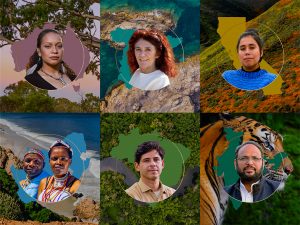
  • Andrea Vidaurre—USA: “Andrea Vidaurre’s grassroots leadership persuaded the California Air Resources Board to adopt, in the spring of 2023, two historic transportation regulations that significantly limit trucking and rail emissions. The new regulations—the In-Use Locomotive Rule and the California Advanced Clean Fleets Rule—include the nation’s first emission rule for trains and a path to 100% zero emissions for freight truck sales by 2036. The groundbreaking regulations—a product of Andrea’s policy work and community organizing—will substantially improve air quality for millions of Californians while accelerating the country’s transition to zero-emission vehicles.” (Support/follow: The People’s Collective for Environmental Justice, and Moving Forward Network)
  • Marcel Gomes—Brazil: “Marcel Gomes coordinated a complex, international campaign that directly linked beef from JBS, the world’s largest meatpacking company, to illegal deforestation in Brazil’s most threatened ecosystems. Armed with detailed evidence from his breakthrough investigative report, Marcel and Repórter Brasil worked with partners to pressure global retailers to stop selling the illegally sourced meat, leading six major European supermarket chains in Belgium, France, the Netherlands, and the United Kingdom to indefinitely halt the sale of JBS products in December 2021.” (Support/follow: Mighty Earth, AidEnvironment, Environmental Investigation Agency, and Repórter Brazil; and please sign this petition.)
  • Teresa Vicente—Spain: “Teresa Vicente led a historic, grassroots campaign to save the Mar Menor ecosystem—Europe’s largest saltwater lagoon—from collapse, resulting in the passage of a new law in September 2022 granting the lagoon unique legal rights. Considered to be the most important saltwater coastal lagoon in the western Mediterranean, the once pristine waters of the Mar Menor had become polluted due to mining, rampant development of urban and tourist infrastructure, and, in recent years, intensive agriculture and livestock farming.”
  • Alok Shukla—India: “Alok Shukla led a successful community campaign that saved 445,000 acres of biodiversity-rich forests from 21 planned coal mines in the central Indian state of Chhattisgarh. In July 2022, the government canceled the 21 proposed coal mines in Hasdeo Aranya, whose pristine forests—popularly known as the lungs of Chhattisgarh—are one of the largest intact forest areas in India.” (On Twitter, follow @SHasdeo and @CBARaipur)
  • Murrawah Maroochy Johnson—Australia: “Murrawah Maroochy Johnson blocked development of the Waratah coal mine, which would have accelerated climate change in Queensland, destroyed the nearly 20,000-acre Bimblebox Nature Refuge, added 1.58 billion tons of CO2 to the atmosphere over its lifetime, and threatened Indigenous rights and culture. Murrawah’s case, which overcame a 2023 appeal, set a precedent that enables other First Nations people to challenge coal projects by linking climate change to human and Indigenous rights.” (Support/follow: Youth Verdict)

Click on each recipient’s name to read a longer profile—or watch a brief video—about their remarkable efforts and achievements.

Posts on Goldman Prize winners from previous years:

Share

April 29, 2024
[Click here to comment]

This is a listing of some legal organizations that I recommend following, learning more about, and potentially supporting. They all use the law to try to serve and support the common good in various ways: to protect humans and human rights, civil rights, and civil liberties; to protect animals and the rights of non-human species; and/or to protect nature, our shared environment, and the livability of our planet.

Many human/societal/commercial/industrial activities and practices that are considered “business as usual” are not only unjust, but are truly ecocidal, genocidal, and collectively suicidal, and really ought to be legally deemed (and prosecuted as) Crimes Against Humanity and the planet. Currently, only some of these existential wrongs can be addressed and enforced through legal avenues. While the law has typically focused on the rights of humans (and human entities, such as companies or organizations), efforts have been ramping up to also establish/enact and secure the Rights of Nature (including rivers, etc.) as well as Non-Human Rights for other species.

In recent years, some countries have amended their constitutions, enacted laws, or issued court decisions recognizing the legal rights of nature. Those countries include: Ecuador, New Zealand, Bolivia, Panama, Mexico, Colombia, Brazil, and Bangladesh. And recently, the UN formally declared that access to a clean, healthy, and sustainable environment is a universal human right. However, this is a non-binding resolution; the hope is that it will help spur countries to improve their environmental laws and the implementation and enforcement of those laws.

Environmental law/rights

Animal rights

Also see our related post:  Animal Protection, Rescue, and Advocacy Organizations

Human/civil/constitutional rights
(including voting rights, bodily autonomy, reproductive rights, etc.)


Related posts:

Organizations for Human Rights, Peace, and Nonviolence

Posts related to Democracy, Elections, Voting, and Social Change

Share

August 2, 2022
[Click here to comment]

The survival of our democracy—and the survival of a habitable environment and climate—depends on having free and fair elections. This post includes some tips and recommendations of specific ways to help preserve the integrity and security of the election: to make sure that your vote and other people’s votes are counted. (Scroll down to see all of our tips, especially item #4 re. mail-in voting vs. voting in person.)

To get started, I hereby offer up the following resources and tools for getting clear, accurate, official information on the voting options and rules in your state/county (beware of disinformation that’s being spread, particularly on social media, and be aware that each state and county has somewhat different voting rules and options). Further down, I have also listed groups that are involved in helping to counter voter suppression (and disinformation and intimidation) tactics and protect the election (from election fraud, tampering, cyber hacking, manipulation, foreign “interference,” or errors; individual voter fraud is almost non-existent and is readily detected, so it is not a major threat).

Please review, use, and share some of these resources and tools:

The Best Way to Vote in Every State: A comprehensive guide to making sure your ballot gets counted, no matter where in America you live (Slate)

Plan Your Vote. Everything you need to know about mail-in and early in-person voting (state by state) (NBC)

State/County Voting Requirements and Information directory (U.S. Vote Foundation)

State by State Voting Information Links (The Green Spotlight)

How to Prevent Your Mail Ballot from Being Rejected (Washington Post)

State Laws on Early Voting (National Conference of State Legislatures)
[Note: 41 states have some form of Early Voting in place.  Only 9 states—Alabama, Connecticut, Kentucky, Mississippi, Missouri, New Hampshire, Pennsylvania, Rhode Island, South Carolina—do not offer pre-Election Day, in-person Early voting options.]

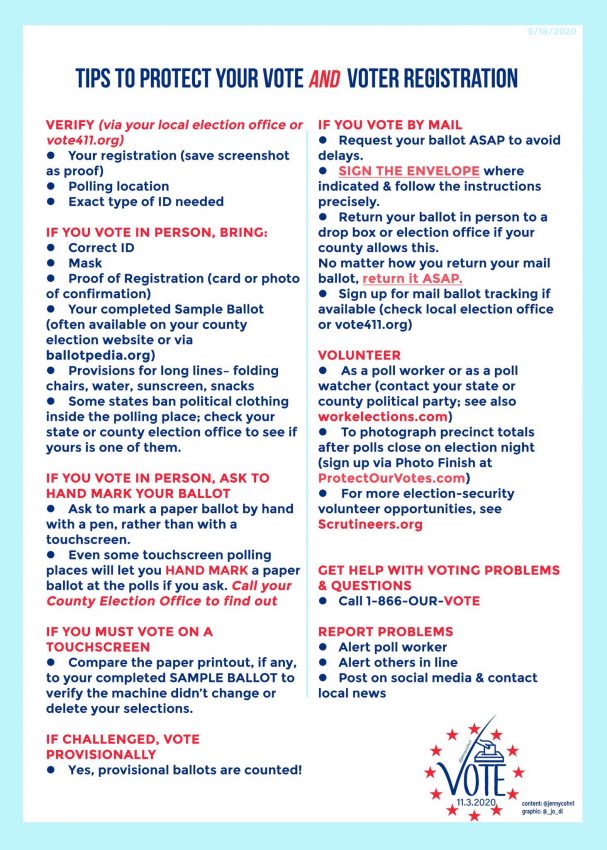
Tips to Mitigate Threats to Our Votes and Voter Registrations Before November (Jennifer Cohn, Protect Our Votes)

Four Ways to Safely Cast Your Ballot Without USPS (Democracy Docket)


Orgs/websites for voting information:

and/or contact your county’s Elections office/department/board/registrar (or your Secretary of State’s elections division) for official, local, up-to-date voting and ballot information.

Orgs/websites re. election protection/integrity/security (including legal action) efforts and safeguards (please click on/follow/share a few, and pick one or two to support/volunteer/join!):

Also follow and share our: 
list of Voting / Elections accounts on Twitter 
and our Twitter posts


TIPS & RECOMMENDATIONS:

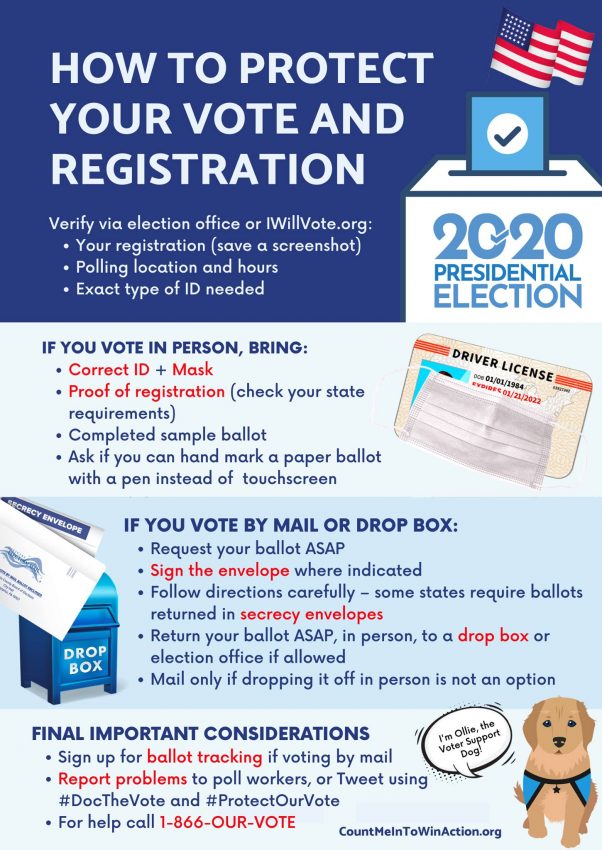
  1. Register early (don’t put it off until your state’s deadline), and re-check your registration periodically, including just over than a month before each election to make sure your name hasn’t been purged and to give you enough time to fix any problems. Make sure your registration has your current address and all of the other information is also correct and has not been altered (name, party preference, etc.). Save a screen shot of your registration and bring that or your registration confirmation card/postcard with you as proof (just in case they say you’re not listed on the voting rolls), if you’re voting in-person.If you move more than a month before the election, re-register to vote right away with your new address. If you have to move within the month before the election, find out if your state allows last-minute or Same-Day Registration during Early Voting or on Election Day; or if you’re moving near-by, ask your County elections office if you are still allowed to vote at the poll location for your old address or what your other options are.
  2. Make sure you have the required ID (if any is required in your state). Go to VoteRiders.org or go to your Secretary of State’s elections website or your County’s elections/voter registrar site to find out whether/what ID is required to vote. If you need help obtaining or paying for the correct ID before the election, contact VoteRiders or Spread the Vote for assistance ASAP.
  3. Ask your County elections office/Registrar of Voters whether your County provides Hand-Marked Paper Ballots on Election Day as well as during Early Voting (preferably as the default option, instead of touchscreen/computer voting machines or ballot-marking devices, but at least as an option that you can request instead of the machines), as well as paper pollbooks (lists of voters) as a backup in case their electronic pollbooks malfunction/fail (e.g., Internet connection or power goes out) or are hacked into and tampered with. Ask/demand that your County and State provide: Hand Marked Paper Ballots, paper pollbooks (at least as backup), and no modem/Internet (i.e. hackable) connections for voting machines or ballot scanners; also tell them they must save all ballots and digital ballot images to allow for audits or recounts. Ask them if they will have plenty of local polling places open throughout your County/State so people won’t have to travel far from their neighborhood to vote. Not everyone has a car. (Providing large, centralized voting “centers” is not a good replacement for having many, neighborhood-based polling places. Also, county-wide voting centers will not have paper pollbooks on hand, which can cause serious problems if the e-pollbooks fail.) For more info on these issues, follow @jennycohn1 on Twitter or see ProtectOurVotes.com.
  4. IF your County provides Hand-Marked Paper Ballots (as regular ballots, not just “provisional,” and they are also provided during Early Voting): I’d generally recommend voting in person (preferably during the Early Voting period to avoid lines and any unexpected issues on Election Day), particularly IF you are young and healthy and you feel confident that your daily schedule will allow you to go vote in person. (Also see #8, 9, and 10 below for more on voting in person.) On the other hand…
    IF your County/precinct (only) uses computerized voting machines (e.g. hackable BMDs or DREs), or IF you are elderly or at high risk if you get COVID, or IF you anticipate extremely long lines in your precinct or not having the time to go vote in person for any reason (work, childcare, etc.): it would be better to request a mail-in/absentee ballot if your state allows that [no-excuse absentee voting is currently allowed in two-thirds of the states]. Please follow these steps:
    1) Apply for your absentee ballot as soon as you are allowed to (don’t wait until the deadline); find info on how to do so on your Secretary of State’s elections site;
    2) When you receive the actual ballot, be sure to read and follow the instructions on it very carefully to make sure you fill it out correctly; sign it where requested (which might be on the return envelope) with your typical signature (the same way you signed when registering to vote or on your driver’s license, for potential “signature matching” issues in some states) so they won’t have any cause to reject it (the GOP will be looking for any excuse to challenge/reject mail-in ballots); unfortunately, rejections of mail-in ballots are frighteningly common, especially for inexperienced voters (please contact your County if you have any questions about their instructions, which are sometimes confusing). Note: If you make a mistake on your ballot, contact your county elections office to find out how/where you can bring your “spoiled” ballot in to have it voided and get a new one (or bring the spoiled ballot to your polling place and have them replace it with a clean ballot).
    3) Return your completed ballot as early as possible, ideally dropping it off directly at your County’s elections office or another designated ballot drop-off location/box within your County (since USPS mail service could be significantly delayed and it might not get post-marked or delivered in time). If you mail it, mail it at least two weeks before the election and with as much postage on the envelope as is required. [Note: Some states will not accept ballots that are mailed via non-USPS services such as UPS or FedEx.]
    4) Look up whether your state/county offers a way to track your ballot and confirm that it has been received and accepted/counted. Track its status if you can. If you find out or are notified that it has been rejected, please go in to “cure” (fix) your ballot if you are allowed to (some areas allow this). Be aware that most places will not start counting any mail-in ballots until Election Day, and some ballots will not be received or counted until after Election Day.
    If you don’t receive your mail-in ballot at least two weeks before the election, report that to your County’s elections office (and Secretary of State), and if it doesn’t arrive in time, go vote in person instead, ideally during Early Voting. If it arrives within the last 10-14 days before the election, do not send the completed ballot back by mail, due to postal delays; drop it off at a designated location instead.
  5. Sign up to be a paid poll worker or “election judge” (for Early Voting and/or for Election Day), as there is a shortage of poll workers in many areas due to COVID (in the past many poll workers have been seniors, but they have good reason to sit this one out due to COVID risks). If there aren’t enough poll workers, counties will close poll locations. See WorkElections.com, Power the Polls, or Poll Hero, or contact your County’s elections office directly to find out how to apply. Be sure to wear a face mask and a face shield when working at the polls.
    Or sign up to be a poll monitor/observer/watcher, to help prevent and report any voter suppression or intimidation, correct or report poll workers who may be providing false information, or other problems at the polls; or to observe the counting of absentee ballots. The Republican Party and the DT campaign plan to deploy an “Army” of “poll watchers” (and intimidators, though that is not legal) and they will be looking for any excuse to challenge and reject ballots, so we need to have plenty of poll monitors and count monitors of our own. Contact your state or local Democratic Party, the Biden campaign, or a local candidate/campaign to sign up to be a poll observer.  #WatchTheVote
  6. Alternatively, volunteer with Election Protection / Common Cause’s Protect The Vote program. People with legal experience can contact We the Action for call center and/or field program opportunities.
    Or “consider volunteering with ProtectOurVotes.com to photograph precinct totals (as shown on precinct poll tapes posted outside many polling places when the polls close) and compare them to the county-reported totals for those precincts. If the two don’t match, this suggests that a potentially serious problem occurred with the tabulation and may support an election challenge.” #PhotoFinish
    You could also volunteer with the Scrutineers. To be involved in additional vote protection efforts on election night and beyond (e.g. taking periodic screenshots of election tally results from state or county websites as votes are counted), see item #21 here, and follow @jennycohn1 on Twitter for other suggestions.
  7. Volunteer for or donate to voter outreach/education/registration, and Get Out the Vote (GOTV) efforts (such as texting voters from your computer), through your state or local Democratic Party, a battleground state’s Dem. Party (e.g., PA, AZ, NC, WI, FL, GA, IA, KS, MI, OH, MT, TX, NV, MN, ME, VA, NH, CO; SC, KY, AL, MS), a specific campaign, or a group such as: Mobilize.US, MoveOn, Swing Left, NextGen America, Indivisible, Democrats Abroad, LastElection.org, Sierra Club, Progressive Turnout Project, When We All Vote, Fair Fight, March for Our Lives, Voto Latino, NALEO, Rock the Vote, Black Voters Matter, More than a Vote, Overseas Vote, Nonprofit Vote, DSCC, DLCC, DCCC, NDRC, or All on the Line, among many others. Also, remind all of your friends to vote!
  8. If voting in person, bring your completed sample ballot with you (which should be sent to you in the mail, or you can download one online) to work off of when filling out your real ballot. Also bring a mask, some water/snacks (maybe some to share too), and perhaps a portable chair/stool if there could be long lines. Offer to drive someone to the polls with you (a senior, young person, neighbor, or someone else who might not have a car). Request a paper ballot that you can mark with a pen. And Jenny Cohn says, “If you must use a touchscreen, compare the human readable text on the paper printout (if any) to your completed sample ballot to ensure the machine didn’t drop or flip your votes. Very few voters will notice such dropping or flipping — especially for down-ballot races — without doing this comparison.” Make sure no races, candidates, or other items are missing.
  9. If you encounter any problems or irregularities (or questions) prior to or during voting, contact the Election Protection hotline at 866-OUR-VOTE (866-687-8683 — save that number in your phone and share it with others; it’s 1-888-VE-Y-VOTA for help in Spanish). If problems are not immediately or adequately resolved, you should also report the issues to your County Elections office, your Secretary of State’s elections division, your state Democratic Party, the DNC, local or national media, on social media; and/or to legal groups such as Democracy Docket, the ACLU, and you can also send/post a note to @jennycohn1 on Twitter. Do not give up on voting without first at least contacting Election Protection for assistance, and do not vote a provisional ballot unless you confirm with Election Protection that that is the only way you will be able to vote. If there are long lines, please stay in line. Anyone who is in line at the time that polls “close” must be allowed to vote.
  10. Keep your ballot receipt/stub (if provided), and look up whether your state/county offers a way to track your ballot and confirm that it has been received and accepted/counted. Track its status if you can. (Some states allow you track your ballots through BallotTrax.) And if it isn’t accepted/counted, report that (see the list of groups in the previous item). In highly populated cities, counties, and states, it could take several weeks for all votes (particularly mail-in and overseas/military ballots, some of which won’t arrive until after Election Day) to be counted. Do not expect final or certified election results immediately after the election. Patience is a virtue. Accuracy is more important than instant gratification. (It is wildly irresponsible for any news media to “call” races prematurely, before almost all votes have actually been counted, including mail-in ballots. Please remind media and others about this on social media.) If the reported results differ significantly from recent polls and exit polls, support recount and audit efforts. We must insist on election transparency, security, integrity, and verifiability, especially at a time when Russian operatives are again actively working to manipulate our election like they did last time.
  11. Avoid sending anything non-crucial (or ordering anything to be shipped) through the US Postal Service (except your mail-in ballot, if you can’t drop it off instead) for the three to four weeks preceding the election, up through the day after the election (from at least Oct. 13 – Nov. 4)—to try to enable the USPS to process all of the ballot mail.


For additional info and tips, see our previous voting posts:

Also follow and share our: 
list of Voting / Elections accounts on Twitter 
and our Twitter posts

I will be adding some more information and links to this post in the coming days and weeks. So please check back again! And please use and share some of this info with friends. We need all hands on deck to protect and save our democracy.

Vote like your life depends on it and everyone’s future depends on it. Vote for democracy, basic decency, health, sanity, justice, facts and rationality, equality, stability, security, fairness, ethics, and a livable environment.

In solidarity. Thank you.


Share

August 31, 2020
[Click here to comment]

These are “things” that I care deeply about and that I believe truly matter and are worth standing up for, protecting, and supporting (in addition to one’s own circles of friends, family, and community):

– A life-sustaining climate
– Clean (unpolluted) air, water, soil/land, and food
– Democracy
– Equality
– Basic decency and respect: the Golden Rule (“Do unto others…”)
– Liberty, self-determination, bodily autonomy, reproductive choice
– Truth, facts
– Justice, fairness, accountability
– Human rights, civil rights, voting rights, women’s rights, reproductive rights, indigenous rights/sovereignty
– Meeting everyone’s basic needs/welfare (food, clean water, shelter/warmth/cooling, clothing); UBI
– Animal rights
– Wild lands, healthy ecosystems, natural habitat, biodiversity, wildlife, endangered species, rights of nature
– Empathy, compassion, kindness, love, mercy (without borders)
– Disabled, ill, vulnerable, homeless, afflicted, and impoverished people (including children)
– Refugees, immigrants/immigration
– Reducing unnecessary suffering
– Non-violence; non-violent protest and dissent; de-escalation of conflict
– Integrity, courage, ethics
– Public health protections, and affordable, universal healthcare (including mental healthcare and vaccines)
– Science; and science-based, evidence-based policy and decision-making
– A free/independent press; investigative journalism; an informed citizenry
– Critical thinking, reason, wisdom, education
– Dignity, self-control, restraint, magnanimity, humility, moderation
– The Common Good

I recommend giving some real thought to your own values and priorities (and desired legacy), and sharing your own mini-manifesto or values/mission statement with others.

As Elie Wiesel so wisely said:

“I swore never to be silent whenever and wherever human beings endure suffering…  We must take sides. Neutrality helps the oppressor, never the victim. Silence encourages the tormentor, never the tormented.”

It’s important for people to show and tell other people what they stand for and will stand up for (and not only the things we stand against).

That said, the opposite of many of the things listed above are things that I stand against, e.g.,:

authoritarianism, fascism, white supremacy/nationalism, theocracy; hatred, dehumanization, discrimination, cruelty, racism, bigotry, sexism, misogyny, patriarchy, rape culture, anti-semitism, Islamophobia, homophobia, transphobia; scapegoating (e.g., of immigrants, people of color, and poor people); violence (including child abuse, domestic violence, violence against women, violence against protestors or by protestors), war-mongering; police brutality, excessive force, abuse of power, mass incarceration, discriminatory judicial decisions and sentencing, victim blaming; corruption, greed, extreme income inequality, exploitation, unequal pay, oligarchy, plutocracy, predatory and exploitative capitalism, money hoarding, upward wealth redistribution from the poor and middle class to the wealthy, materialism and over-consumption, industry (private profit-driven) influence/control over policies, regulations, and laws; selfish individualism and personal entitlement at the expense of the health or well-being of others (e.g., neighbors, humanity, future generations, other species, etc.); pollution; the production, use, and dumping of toxins and toxic waste (including nuclear); fossil fuel extraction and burning; gerrymandering, voter suppression and voter intimidation and voter disenfranchisement, election hacking and fraud; propaganda, lying, disinformation, misinformation, “information warfare,” smears, anti-science sentiment and policy, disproven conspiracy theories, paranoia, fear-mongering, denial of facts, willful/proud ignorance, hypocrisy, trolls, tabloids, sensationalist media, “artificial intelligence;” portraying/covering politics and elections as a game, sport, horse race, or entertainment; harassment, doxxing, bullying, humiliation, ridicule, personal attacks; animal cruelty, exploitation and commodification, neglect, poaching, poisoning, habitat destruction, over-hunting; human supremacy; the contamination and depletion of natural resources.

-ML


NEW: Posts related to Democracy, Voting, Elections, Social Change

Share

May 20, 2019
[Click here to comment]