The Goldman Environmental Prize is the world’s largest and most prestigious annual award for grassroots environmentalists. Many people refer to it as the “green Nobel.” Goldman Prize winners are models of courage, and their stories are powerful and truly inspiring. “The Prize recognizes individuals for sustained and significant efforts to protect and enhance the natural environment, often at great personal risk. Each winner receives a financial award. The Goldman Prize views ‘grassroots’ leaders as those involved in local efforts, where positive change is created through community or citizen participation in the issues that affect them. Through recognizing these individual leaders, the Prize seeks to inspire other ordinary people to take extraordinary actions to protect the natural world.” Over the 32 years that the Prize has been awarded, there have been more than 200 recipients of the prize.
This year’s prize recipients (one from each of the six inhabited continental regions of the world) are:
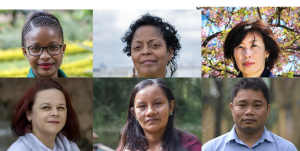
- Sharon Lavigne—Louisiana, USA: In September 2019, Sharon Lavigne, a special education teacher turned environmental justice advocate, successfully stopped the construction of a US$1.25 billion plastics manufacturing plant alongside the Mississippi River in St. James Parish, Louisiana. Lavigne mobilized grassroots opposition to the project, educated community members, and organized peaceful protests to defend her predominantly African American community. The plant would have generated one million pounds of liquid hazardous waste annually, in a region already contending with known carcinogens and toxic air pollution. (Support: RISE St. James, Stop Formosa Plastics, and Louisiana Bucket Brigade)
- Liz Chicaje Churay—Peru: In January of 2018, as a result of the efforts of Liz Chicaje Churay and her partners, the Peruvian government created Yaguas National Park. Comparable in size to Yellowstone National Park, the new park protects more than two million acres of Amazon rainforest in the northeastern region of Loreto. Its creation is a key step in conserving the country’s biodiversity—safeguarding thousands of rare and unique wildlife species and conserving carbon-rich peatlands—and protecting Indigenous peoples. (Support: Instituto del Bien Comun and Amazon conservation organizations)
- Kimiko Hirata—Japan: After the Fukushima Daiichi nuclear disaster of 2011, Japan was forced to move away from nuclear power and, in its place, embraced coal as a major energy source. Over the past several years, Kimiko Hirata’s grassroots campaign led to the cancellation of 13 coal power plants (7GW or 7,030MW) in Japan. These coal plants would have released more than 1.6 billion tons of CO2 over their lifetimes. The carbon impact of Hirata’s activism is the equivalent of taking 7.5 million passenger cars off the road every year for 40 years. (Support: Kiko Network, Japan Beyond Coal, and 350.org)
- Thai Van Nguyen—Vietnam: Thai Van Nguyen founded Save Vietnam’s Wildlife, which rescued 1,540 pangolins from the illegal wildlife trade between 2014 and 2020. Nguyen also established Vietnam’s first anti-poaching unit, which, since 2018, has destroyed 9,701 animal traps, dismantled 775 illegal camps, confiscated 78 guns, and arrested 558 people for poaching, leading to a significant decline in illegal activities in Pu Mat National Park. Pangolins are the world’s most heavily trafficked mammal despite an international trade ban. Heavy demand for their meat, scales, and blood threatens pangolins with extinction; all eight pangolin species are on the IUCN Red List. (Support: Save Vietnam’s Wildlife, WildAid, and Pangolin Crisis Fund)
- Gloria Majiga-Kamoto—Malawi: Concerned about the environmental harm caused by mounting plastic pollution in Malawi, Gloria Majiga-Kamoto fought the plastics industry and galvanized a grassroots movement in support of a national ban on thin plastics, a type of single-use plastic. As a result of her dedicated campaigning, in July 2019, Malawi’s High Court upheld the ban on the production, importation, distribution, and use of thin plastics. This is the first Prize for Malawi. (Support: Break Free From Plastic, GAIA Zero Waste World, and Lilongwe Wildlife Trust)
- Maida Bilal—Bosnia and Herzegovina: Maida Bilal led a group of women from her village in a 503-day blockade of heavy equipment that resulted in the cancellation of permits for two proposed dams on the Kruščica River in December 2018. The Balkans are home to the last free-flowing rivers in Europe. However, a massive hydropower boom in the region threatens to irreversibly damage thousands of miles of pristine rivers. This is the first Prize for Bosnia and Herzegovina. (Support: RiverWatch, Patagonia, EuroNatur, and EKO BISTRO)
Click on each recipient’s name to read a longer profile—or watch a brief video—about their remarkable efforts and achievements.
Here’s the video about Sharon Lavigne:
Posts on Goldman Prize winners from previous years:
- Goldman Prize Winners, 2020
- Goldman Prize Winners, 2019
- Goldman Prize Winners, 2018
- Goldman Prize Winners, 2017
- Goldman Prize Winners, 2016
- Goldman Prize Winners, 2015
- Goldman Prize Winners, 2014
- Goldman Prize Winners, 2013
- Goldman Prize Winners, 2012
- Goldman Prize Winners, 2011
- Goldman Prize Winners, 2010

